 WAR ATLAS MILITARY HISTORY MAGAZINE · WWI — WWII
P-40 Warhawk
1. Lead
The Curtiss P-40 Warhawk was the most widely used American fighter of the first half of the Second World War. First flown in 1938 and built in greater numbers than any other American fighter except the P-47 Thunderbolt and the P-51 Mustang, the P-40 equipped 28 Allied air forces and fought on every front, from the deserts of North Africa to the jungles of New Guinea and the frozen airfields of the Soviet Union.
It was never the fastest or the most elegant fighter of its generation, and at high altitude it was outclassed by its German and Japanese rivals. What it offered instead was toughness, availability and honesty: a rugged airframe, heavy firepower, good diving speed and a forgiving nature that made it an excellent aircraft for young pilots and for the brutal, low-level fighting that dominated much of the war in the air.
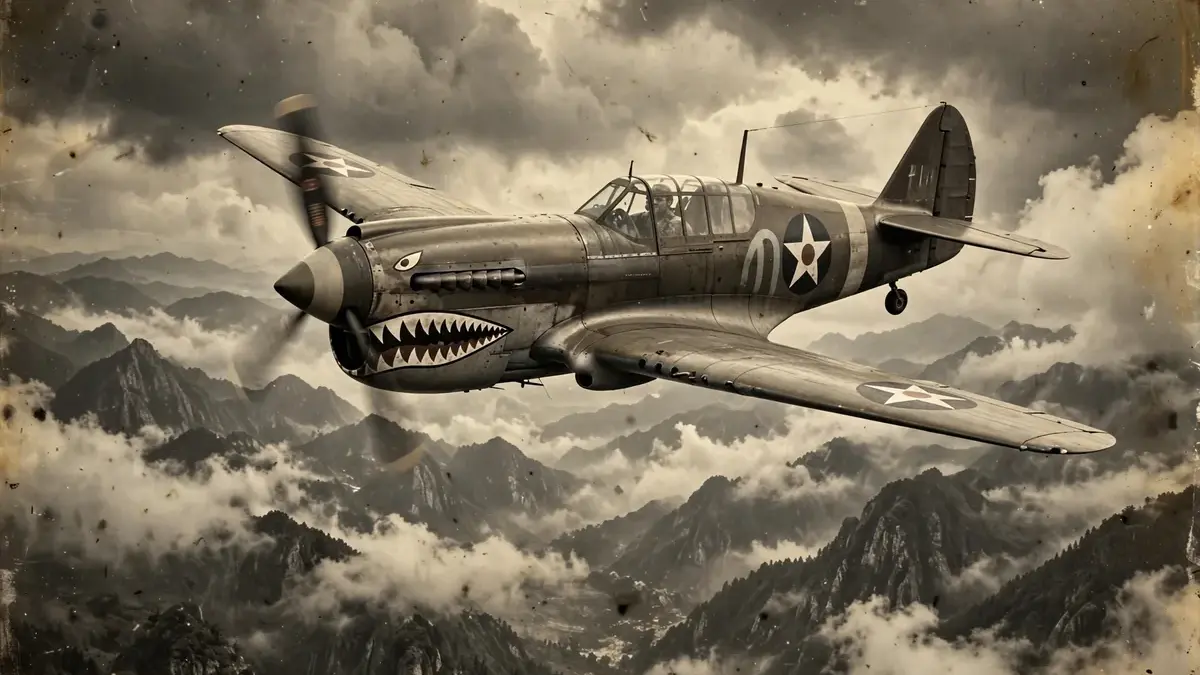
Its most famous incarnation was the shark-mouthed P-40 of the American Volunteer Group — the Flying Tigers — whose exploits over China in 1941–1942 made the aircraft a symbol of defiance at a time when the Allies had little else to celebrate.
By the time production ended in 1944, 13,738 P-40s had been built, and the type had flown in the defence of Pearl Harbor, the campaign in the Mediterranean, the struggle for Guadalcanal and the long advance across the Pacific.
2. Key Facts
The table below summarises the P-40 Warhawk in its most numerous wartime form, the P-40E, with the main production figures for the whole family.
| Type | Single-seat, single-engine fighter and fighter-bomber |
| Country of origin | United States (Curtiss-Wright, Buffalo, New York) |
| First flight | 14 October 1938 (XP-40 prototype) |
| Entered service | 1940 (US Army Air Corps); combat 1941 |
| Number built | 13,738 (1939–1944) |
| Crew / Kíp lái | 1 pilot |
| Engine | Allison V-1710-39 liquid-cooled V-12, 1,150 hp |
| Maximum speed | About 362 mph (582 km/h) at 15,000 ft (P-40E) |
| Range | About 750 miles (1,200 km) on internal fuel |
| Service ceiling | About 29,000 ft (8,800 m) |
| Armament | 6 × .50 in (12.7 mm) Browning M2 machine guns; up to 1,500 lb (680 kg) of bombs (P-40E and later) |
| Main users | United States, United Kingdom, Soviet Union, China, Australia, New Zealand, Canada, South Africa |
| Famous unit | American Volunteer Group, the “Flying Tigers”, China 1941–1942 |
3. Background
3.1. The fighter gap of the late 1930s
In the late 1930s the United States Army Air Corps faced an uncomfortable truth: its front-line fighters were obsolete. The standard pursuit aircraft of the period, the Boeing P-26 Peashooter and the Seversky P-35, were outclassed by the new monoplane fighters appearing in Europe — the Messerschmitt Bf 109 in Germany, the Hawker Hurricane and Supermarine Spitfire in Britain, and the fast Soviet Polikarpov I-16.
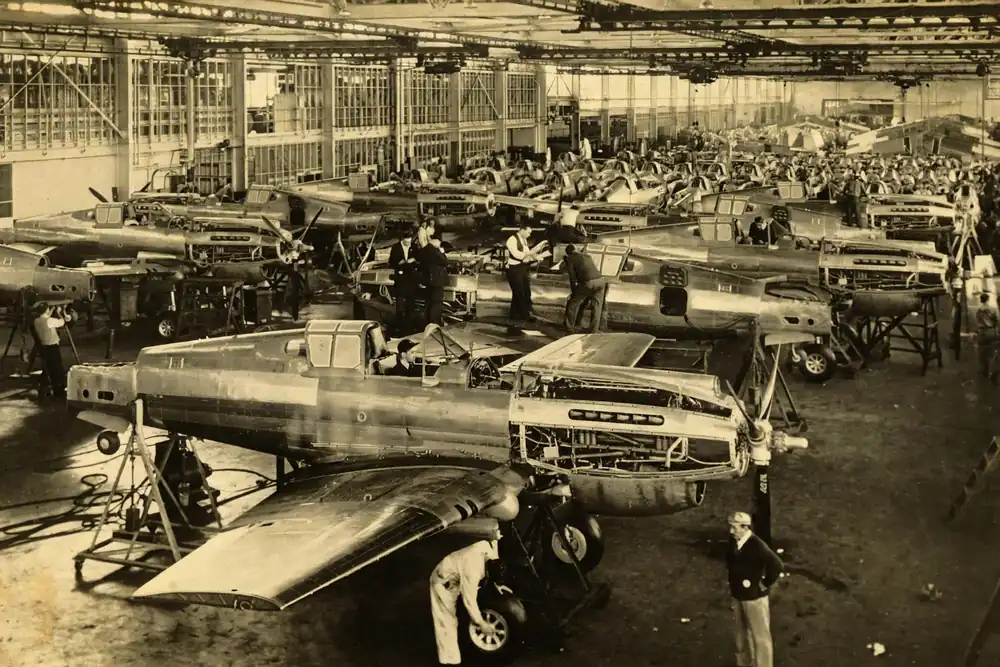
The United States had the industrial capacity to build better aircraft, but it had spent the decade on small orders and cautious development, and it lacked a modern fighter in production. The Munich crisis of 1938 and the outbreak of war in Europe in September 1939 turned that gap from an embarrassment into an emergency.
The Air Corps needed a fighter that could be built quickly, in large numbers, from an existing design, because there was no time to wait for a perfect aircraft that existed only on paper. The P-40 was the answer to that emergency: not a revolutionary design, but a proven airframe fitted with the best engine available, ordered in quantities that no other American fighter could yet match.
3.2. From the P-36 Hawk to the XP-40
The P-40 began life as the Curtiss P-36 Hawk, a radial-engined fighter that had won the Air Corps’ 1937 fighter competition and entered service in 1938. The P-36 was a sound, agile aircraft, but its air-cooled radial engine limited its speed, and by 1938 Curtiss knew it needed a more powerful powerplant.
The company took the tenth production P-36 airframe, replaced the radial engine with the new Allison V-1710 liquid-cooled V-12, moved the cockpit rearwards, fitted a new radiator under the nose, and redesignated the result the XP-40. The change was dramatic: top speed rose from about 300 mph to 342 mph in the prototype, and the aircraft’s sleek, low-drag nose gave it a thoroughly modern appearance.
The Air Corps ordered 524 P-40s in April 1939 — the largest American fighter order since the First World War — before the prototype had even completed its full test programme. It was a gamble on speed of delivery over refinement, and it set the pattern for the P-40’s whole career: the aircraft would be improved in a long series of small steps rather than redesigned, because the factories could not afford to stop.
3.3. Foreign orders and the road to war
The P-40’s early survival owed as much to foreign buyers as to the American government. France ordered 100 P-40s in October 1939 as part of its desperate rearmament, and Britain took over the French order after the fall of France in June 1940, ordering hundreds more under the names Tomahawk and Kittyhawk.
These export orders kept the Curtiss factory in Buffalo busy at a time when American appropriations were still modest, and they gave the P-40 its first combat experience in British and Commonwealth hands, in North Africa and the Middle East, months before the United States entered the war.
The British experience was mixed: the Tomahawk was rugged and well armed, but its Allison engine lost power above 15,000 feet, and it could not match the Bf 109 at altitude. British pilots learned to fight the P-40 at low and medium altitudes, where it was fast in a dive and could out-turn its opponents, and they passed those lessons on to the Americans.
By December 1941, when Japan attacked Pearl Harbor, the P-40 was already the most numerous fighter in American service, and it would bear the brunt of the air war in the Pacific for the next two years.
4. Design and Development
4.1. Airframe and the Allison engine
The P-40’s airframe was a conventional all-metal, low-wing monoplane with a retractable tailwheel undercarriage, and its most distinctive feature was the deep chin radiator slung beneath the nose, which gave the aircraft its aggressive, jutting profile. The structure was built to be strong rather than light: the wing used five spars, the fuselage was heavily riveted, and the aircraft could absorb battle damage that would have destroyed more delicate fighters.
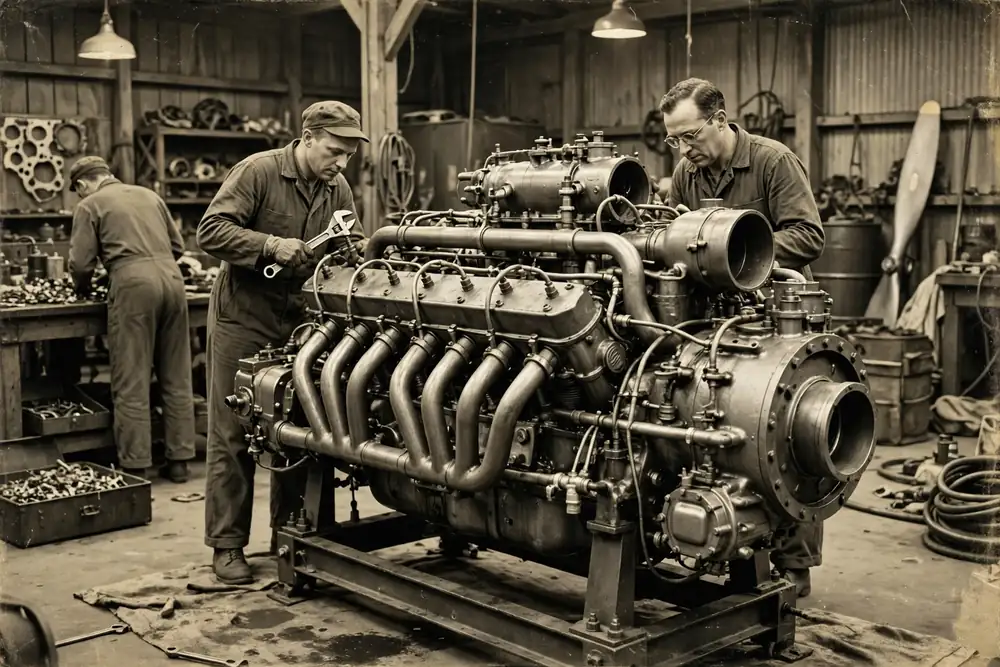
That strength was one of the reasons pilots trusted the P-40, and one of the reasons it survived as a fighter-bomber long after it had ceased to be competitive as a pure interceptor. The engine that powered it, the Allison V-1710, was the only American liquid-cooled V-12 in large-scale production at the start of the war, and it was a sound, reliable unit that produced about 1,040 horsepower in the early P-40 and 1,150 horsepower in the P-40E.
Its fatal weakness was the absence of an efficient two-stage supercharger, which meant that its power fell away sharply above 15,000 feet. Curtiss and Allison worked on supercharger improvements throughout the war, but the definitive fix — the two-stage supercharger fitted to the P-51 Mustang — never reached the P-40 in a production form, and the aircraft’s high-altitude performance remained its permanent limitation.
4.1.1. The Allison V-1710 in detail
The Allison V-1710 was a 1,710-cubic-inch (28-litre) V-12 that first ran in 1930 and entered production for the P-40, the P-38 Lightning and the P-39 Airacobra. In the P-40E it drove a three-blade Curtiss Electric propeller and was rated at 1,150 horsepower for take-off, with a single-stage, single-speed supercharger that gave its best performance at about 12,000 feet.
The engine was liquid-cooled, which allowed the slim nose that made the P-40 faster than the radial-engined P-36, but the cooling system was also a vulnerability: a single bullet through the radiator or the coolant lines could bring the aircraft down, and the chin radiator itself was a large, exposed target in head-on attacks.
Mechanics liked the Allison because it was simple to maintain and tolerant of rough field conditions, and it ran well on the low-octane fuel available in the early war years. Its reliability was one of the P-40’s genuine strengths, and it helps explain why the aircraft remained in front-line service in the Mediterranean and the Pacific until 1944, long after its performance had been overtaken.
Later P-40 models received the V-1710-81 and -99 engines of up to 1,360 horsepower, but the extra power could not cure the altitude problem, because the supercharger, not the basic engine, was the limiting factor.
4.2. Armament and protection
The P-40’s armament grew steadily through its production life, and it was one of the areas in which the aircraft was genuinely competitive. The first P-40s carried two synchronised .50-calibre machine guns in the nose, a light armament by European standards, but the P-40B added two .30-calibre guns in the wings, and the P-40E — the most numerous variant — carried six wing-mounted .50-calibre Browning M2 machine guns with about 280 rounds per gun, a battery that could shred an enemy fighter or a lightly armoured ground target in a single burst.
From the P-40E onwards the aircraft could also carry a 500-pound bomb under the fuselage or two smaller bombs under the wings, and later models could carry up to 1,500 pounds of bombs or a drop tank, which turned the P-40 into an effective fighter-bomber.
Protection improved in parallel: the P-40B introduced armour plate behind the pilot and a bullet-resistant windscreen, and self-sealing fuel tanks became standard, which sharply reduced the risk of fire. These were not glamorous improvements, but they were the ones that kept pilots alive, and they reflected the hard lessons of combat in 1940 and 1941, when unprotected fighters had burned with terrifying ease.
4.3. Production and the Kittyhawk line
Curtiss built the P-40 at Buffalo, New York, and at its peak the factory turned out more than 500 aircraft a month, a rate that made the P-40 the backbone of American fighter production in 1941 and 1942. The production run was organised as a sequence of lettered variants — P-40, P-40B, P-40C, P-40D, P-40E, P-40F, P-40K, P-40L, P-40M and P-40N — with the British names Tomahawk for the early models and Kittyhawk for the later ones, and the American name Warhawk applied to the whole family.
The P-40F introduced a Rolls-Royce Merlin engine built under licence by Packard, which improved high-altitude performance, but Merlin supplies were reserved for the P-51 Mustang, and only 1,311 Merlin-engined P-40s were built. The definitive wartime model was the P-40N, of which 5,220 were built, more than any other single variant: it was lighter, faster and longer-ranged than its predecessors, with a top speed of about 378 mph, and it served as the standard P-40 of the last two years of the war.
Production ended in November 1944, by which time the P-51 and the P-47 had taken over the fighter role, and the P-40’s factories were converted to other work.
5. Technical Specifications
5.1. Performance in the air
The figures most often quoted for the P-40E — a maximum speed of about 362 mph at 15,000 feet, a service ceiling of about 29,000 feet and a range of about 750 miles on internal fuel — describe an aircraft that was fast enough at low and medium altitude but mediocre above 20,000 feet, where its Allison engine lost power and its controls grew heavy.
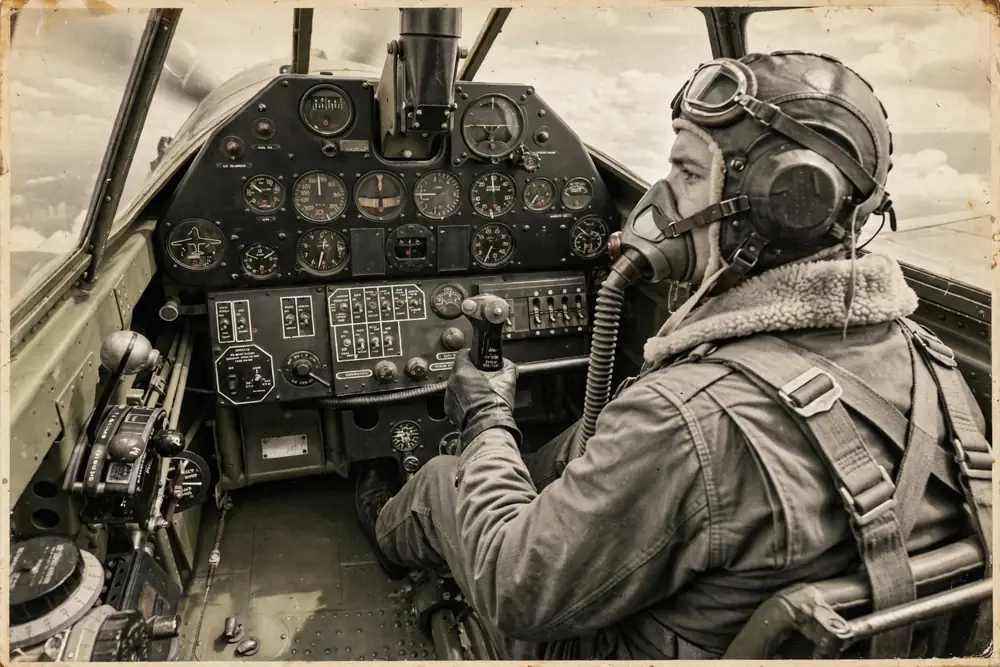
The P-40’s best qualities in the air were its diving speed and its structural strength: it could out-dive the Mitsubishi A6M Zero and the Bf 109, and it could pull out of a steep dive at speeds that would have torn the wings off lighter fighters.
Its rate of climb was modest, about 2,100 feet per minute, and its turning circle was wider than the Zero’s, so pilots were taught never to turn with a Japanese fighter and instead to use the dive, the zoom climb and the head-on pass.
The P-40N improved the numbers slightly — about 378 mph top speed and a longer range with drop tanks — but it did not change the aircraft’s character. What the numbers do not show is the P-40’s reliability in the field: it could operate from rough, dusty or muddy airstrips, it tolerated poor maintenance, and it brought its pilots home with damage that would have grounded other types.
5.2. Armament, load and dimensions
The P-40E measured 31 feet 9 inches (9.68 metres) in length, with a wingspan of 37 feet 4 inches (11.38 metres) and a height of 10 feet 7 inches (3.23 metres), and its empty weight was about 6,350 pounds (2,880 kilograms), rising to a maximum take-off weight of about 9,200 pounds (4,170 kilograms).
Its six .50-calibre guns were the standard American fighter armament of the war and gave the P-40 a weight of fire that compared well with anything in service in 1942, while the bomb load of up to 1,500 pounds allowed it to attack airfields, bridges, vehicles and troop concentrations with useful effect.
The aircraft carried about 120 gallons of internal fuel, and with a 52-gallon drop tank its range extended to roughly 1,100 miles, enough for the long escort and ground-attack missions flown in the Pacific and in Burma. The cockpit was roomy by the standards of the day and gave the pilot a good view to the sides and downwards, though the view to the rear was poor, a common fault of the period.
The undercarriage retracted rearwards into the wings, and the aircraft’s wide track made it stable on the ground, an important quality on the rough forward airstrips where the P-40 spent most of its war.
| P-40E Warhawk / P-40E Warhawk | |
|---|---|
| Length | 31 ft 9 in (9.68 m) / 9,68 m |
| Wingspan | 37 ft 4 in (11.38 m) / 11,38 m |
| Height | 10 ft 7 in (3.23 m) / 3,23 m |
| Empty weight | About 6,350 lb (2,880 kg) |
| Max take-off weight | About 9,200 lb (4,170 kg) |
| Engine | Allison V-1710-39, 1,150 hp |
| Max speed | About 362 mph (582 km/h) at 15,000 ft |
| Range | About 750 miles (1,200 km) internal |
| Ceiling | About 29,000 ft (8,800 m) |
| Guns | 6 × .50 in Browning M2 |
| Bomb load | Up to 1,500 lb (680 kg) |
5.3. Flying qualities and handling
Pilots who flew the P-40 generally liked it, and the reasons they gave were practical rather than poetic: it was stable as a gun platform, it was strong, it was predictable at the stall, and it forgave mistakes that would have killed a pilot in a less forgiving aircraft.
The controls were heavy at high speed, particularly the ailerons, and the aircraft needed a firm hand in a dive, but it was honest — it did what the pilot asked, and it warned the pilot before it stalled. At low altitude the P-40 was fast, and its roll rate was good enough to make it a difficult target in a turning fight, provided the pilot kept his speed up.
The main handling complaints were the poor rearward visibility, the heavy controls at high altitude, and the long take-off run when heavily loaded with bombs and fuel. Ground crews appreciated the aircraft for a different reason: the Allison engine and the simple systems were easy to maintain with basic tools, and the P-40 could be kept flying in conditions — dust, mud, heat, cold — that grounded more sophisticated types.
That maintainability mattered enormously in New Guinea, in Burma and in the Soviet Union, where spare parts were scarce and the airfields were often little more than cleared strips of ground.
5.3.1. The dive as a weapon
The P-40’s diving performance was its most important tactical asset, and the pilots who survived the early war learned to build their tactics around it. In a dive the P-40 accelerated quickly and remained controllable at speeds above 400 mph, where the Zero’s controls stiffened and its light airframe began to flex, and where the Bf 109’s elevator also grew heavy.
The standard P-40 tactic against the Zero was the “boom and zoom”: dive from above, fire a short burst, and climb away before the enemy could turn onto the attacker’s tail, then repeat the attack from a fresh height advantage. The tactic demanded discipline, because the temptation to stay and turn with the enemy was strong, and the pilots who gave in to it usually died.
The Flying Tigers refined the technique in China, where Claire Chennault drilled his pilots in two-ship elements, strict radio discipline and the hit-and-run attack, and the same tactics were later adopted by American units in the Pacific. The dive was also the P-40’s escape: a pilot in trouble could push the nose down, outrun his pursuer in the dive, and break off the fight on his own terms, a luxury that few Allied fighters of 1941 could offer.
6. Variants
6.1. Early models: Tomahawk
The first production P-40s were delivered to the US Army Air Corps in 1940, and the early variants — the P-40, P-40B and P-40C — were known in British service as the Tomahawk. The P-40B, of which 131 were built, introduced armour and self-sealing tanks, and it was the model flown by the American Volunteer Group in China, where its shark mouth became famous.
The P-40C added a larger fuel capacity and an improved radio, and 193 were built, many of them going to Britain and the Soviet Union under Lend-Lease. These early aircraft were the lightest and most agile of the family, but they were also the most lightly armed, with two .50-calibre guns in the nose and two .30-calibre guns in the wings, and their performance fell off sharply above 15,000 feet.
Their combat record was nevertheless respectable: in British hands in North Africa the Tomahawk held its own against Italian fighters and early Bf 109s at low altitude, and in China the Flying Tigers used it to devastating effect against Japanese bombers.
The Tomahawk’s limitations were real, but they were the limitations of an aircraft designed in 1938, and the type did its work while better fighters were still on the drawing board.
6.2. The Kittyhawk line and the P-40N
The P-40D introduced a redesigned nose with the chin radiator moved forward and six wing guns, and from the P-40E onwards the aircraft was known in British service as the Kittyhawk. The P-40E was the most numerous early Kittyhawk, with 2,320 built, and it became the standard P-40 of the Mediterranean and Pacific theatres in 1942 and 1943.
The P-40F fitted the Packard Merlin engine, which improved high-altitude speed to about 370 mph, but only 1,311 were built because Merlin production was reserved for the Mustang. The P-40K, P-40L and P-40M were incremental improvements in engine power and equipment, and the P-40L was lightened for the fighter role by removing two guns and some armour.
The final and most numerous variant was the P-40N, with 5,220 built: it had a lighter airframe, a more powerful Allison engine, a longer range and a top speed of about 378 mph, and it served as the standard American and Commonwealth P-40 of 1944.
The P-40N was also the variant most often used as a fighter-bomber in the Pacific, where its bomb load and its ruggedness mattered more than its performance as a pure fighter.
7. Combat Service
7.1. China and the Flying Tigers
The P-40’s most celebrated combat service was in China, where the American Volunteer Group — the Flying Tigers — flew P-40Bs against the Japanese from December 1941 to July 1942. The group was organised by Claire Chennault, a retired American officer who had advised the Chinese Air Force, and it was manned by American pilots who had resigned their commissions to fight as volunteers before the United States formally entered the war.
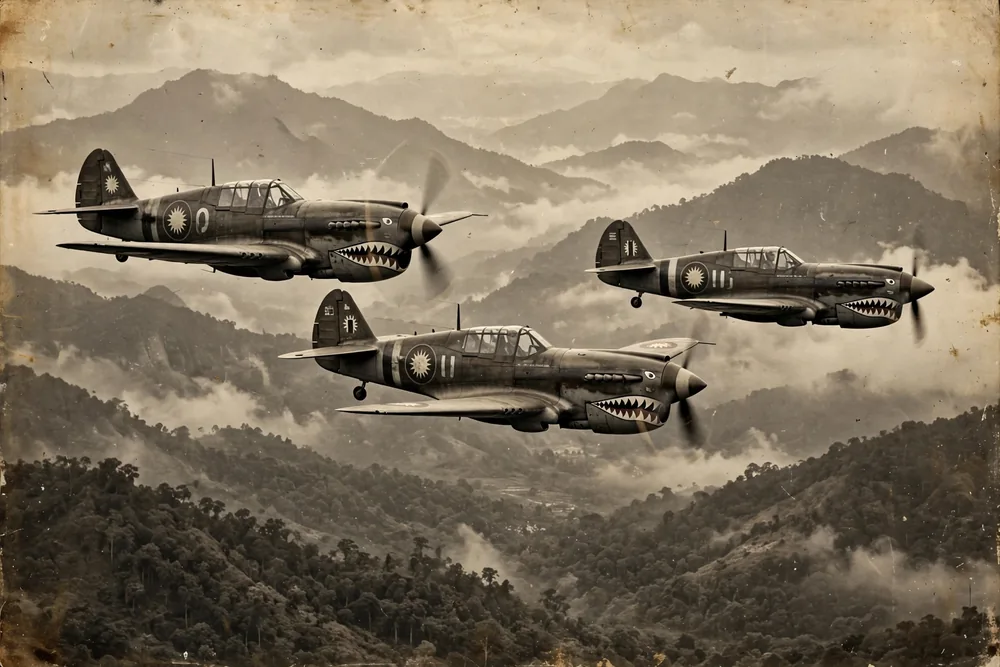
Chennault’s pilots were forbidden to dogfight with the more agile Japanese fighters and were instead drilled in the two-ship element, the diving attack and the hit-and-run, tactics that played to the P-40’s strengths and masked its weaknesses. The results were remarkable: the Flying Tigers claimed nearly 300 Japanese aircraft destroyed in the air and on the ground, a figure that later historians have revised downwards to roughly 115 confirmed air victories, but which was nevertheless an outstanding achievement for a force that never numbered more than about sixty serviceable aircraft.
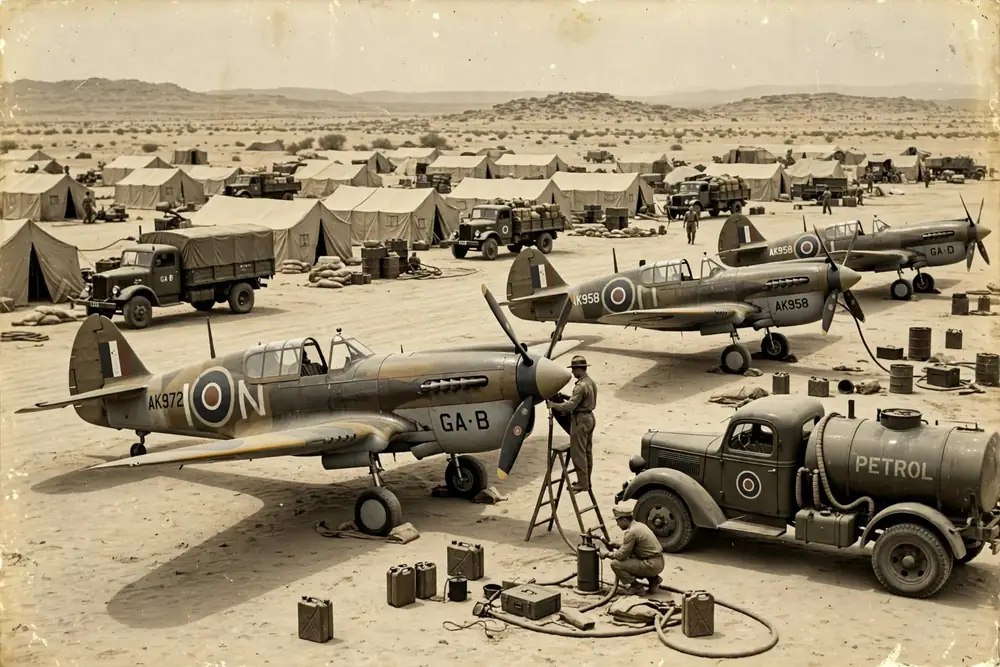
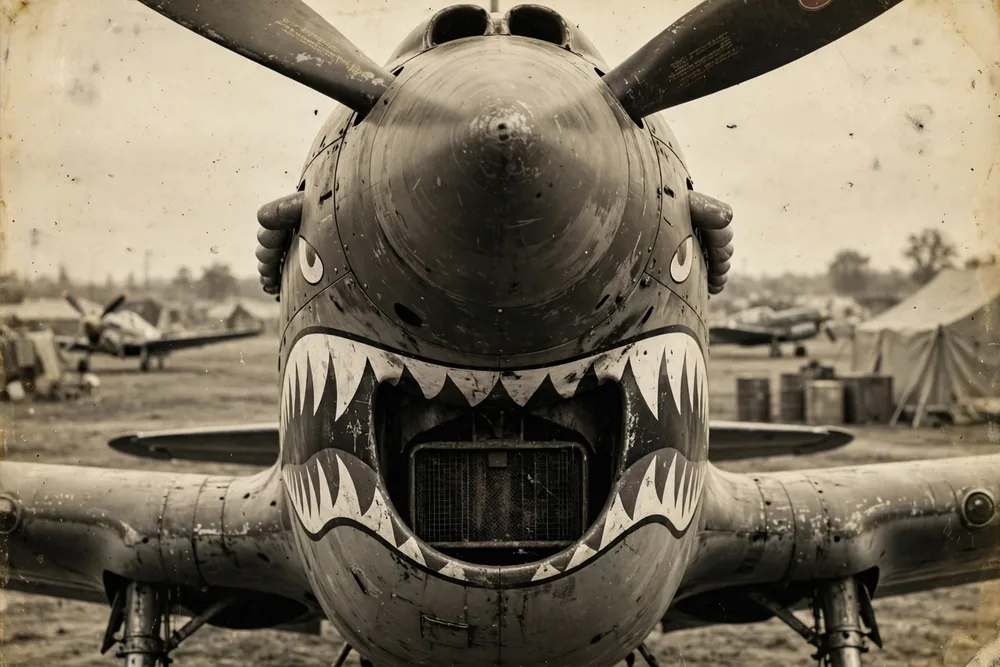
The group’s shark mouth — copied from a Royal Air Force squadron in North Africa — became the most famous nose art of the war, and it was adopted by P-40 units all over the world. When the American Volunteer Group was disbanded in July 1942 and absorbed into the US Army Air Forces as the 23rd Fighter Group, the P-40 remained in China, and it fought there until the end of the war.
7.2. North Africa and the Mediterranean
In North Africa the P-40 served with the Royal Air Force’s Desert Air Force and with the US Army Air Forces, and it was there that the aircraft’s career as a fighter-bomber began in earnest. The British Tomahawks and Kittyhawks flew top cover for the Eighth Army, attacked Axis airfields and supply columns, and fought the Luftwaffe’s Bf 109s and the Italian Macchi C.202s at low altitude, where the P-40 was competitive.
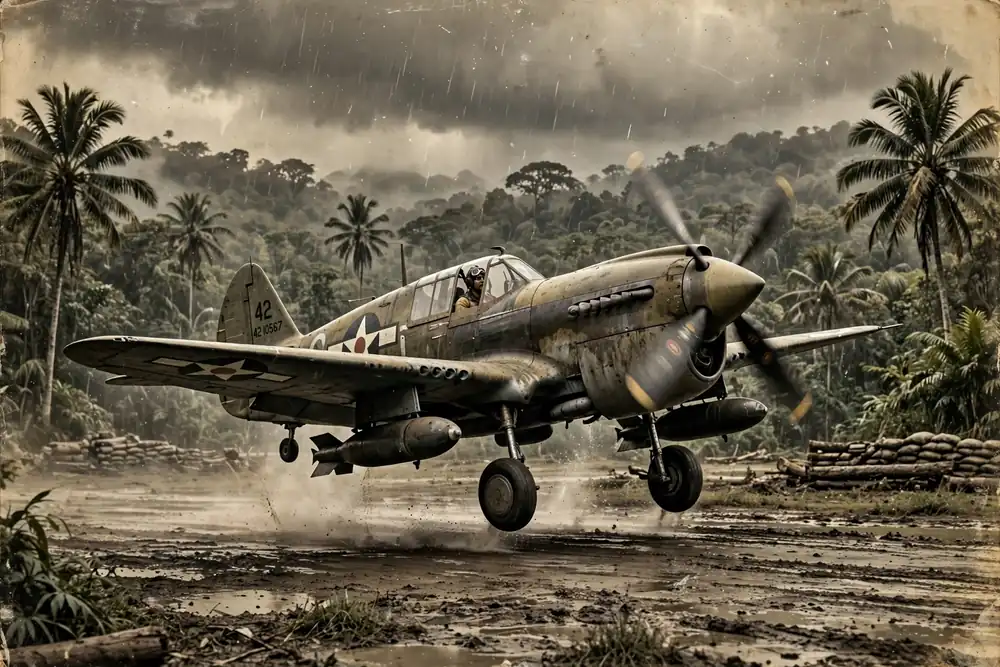
The American 57th, 79th and 324th Fighter Groups flew P-40s in the Tunisian campaign and then in Sicily and Italy, where the aircraft’s bomb load and its ability to operate from rough forward strips made it an excellent close-support aircraft.
The P-40’s most famous Mediterranean action was the defence of the island of Malta, where a small number of Kittyhawks reinforced the island’s Spitfires in 1942, and its most sustained work was the long interdiction campaign against German supply lines in Italy, in which P-40 fighter-bombers attacked bridges, railways and road convoys day after day.
By 1944 the P-40 was being replaced in the Mediterranean by the P-47 and the P-51, but it had done the hard work of the middle years of the war, when the Allies had no better fighter-bomber to offer.
7.3. The Pacific and the Soviet Union
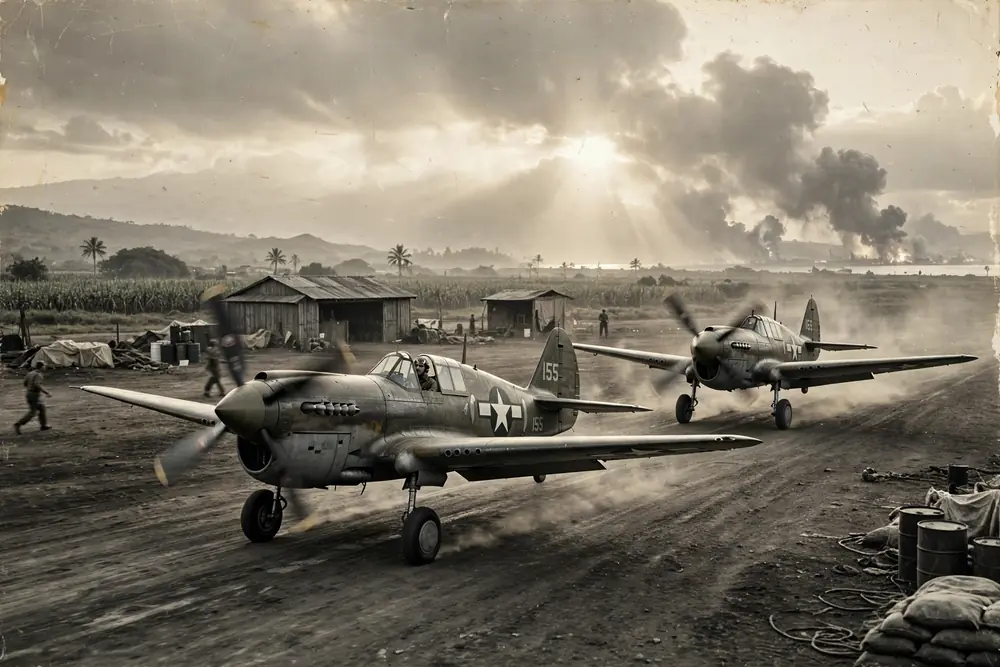
In the Pacific the P-40 was the fighter that held the line in 1942, when the Allies had nothing better. P-40s fought over Pearl Harbor on 7 December 1941 — a handful of pilots, among them George Welch and Kenneth Taylor, got airborne during the attack and shot down several Japanese aircraft — and they fought in the Philippines, in Java, in New Guinea and at Guadalcanal, where the 67th Fighter Squadron’s P-40s operated from Henderson Field under appalling conditions.
In New Guinea the P-40’s ability to operate from muddy strips and its strength as a fighter-bomber made it the mainstay of the Fifth Air Force until the P-38 and the P-47 arrived in numbers. The Soviet Union received about 2,000 P-40s under Lend-Lease, and Soviet pilots used them for air defence and ground attack, particularly around Leningrad and in the Arctic, where the P-40’s ruggedness and its tolerance of cold were valued.
Soviet pilots were less enthusiastic about the P-40’s high-altitude performance, and they generally preferred the P-39 Airacobra, but the P-40 did useful work, and several Soviet aces scored victories in it. By 1944 the P-40 was being withdrawn from front-line fighter squadrons in the Pacific, but it continued to serve as a fighter-bomber and in second-line roles until the end of the war.
7.3.1. Pearl Harbor, 7 December 1941
The P-40’s first combat in American service came on the morning of the Japanese attack on Pearl Harbor, and it was a baptism of fire that showed both the aircraft’s qualities and the chaos of that day. Most of the P-40s on Oahu were parked in neat rows on the airfields at Wheeler and Bellows, where they were easy targets, and the majority were destroyed on the ground.
A handful of pilots managed to get their aircraft airborne, among them Second Lieutenants George Welch and Kenneth Taylor, who took off from Haleiwa Field in P-40Bs and shot down several Japanese aircraft between them — Welch is credited with four victories that day and Taylor with two, though the exact numbers remain a matter of historical debate.
Their achievement was remarkable, not least because they flew without orders, in aircraft that had been fuelled and armed for a training flight, and against an enemy that outnumbered them many times over. The two men were initially recommended for the Medal of Honor, but the awards were downgraded to the Distinguished Service Cross, a decision that remained controversial for decades.
The Pearl Harbor story became part of the P-40’s legend, and it was retold in the film Tora! Tora! Tora! and in Pearl Harbor, though both films took liberties with the details.
8. Strengths and Weaknesses
8.1. Strengths
The P-40’s strengths were practical and interlocking, and they explain why the aircraft remained useful long after its performance had been overtaken. Its airframe was exceptionally strong, and it could absorb damage — flak, machine-gun fire, even collisions with the ground — that would have destroyed a lighter fighter, and it could bring its pilot home with holes in the wings, a damaged tail or a leaking fuel tank.
Its diving speed was excellent, and it could out-dive the Zero and the Bf 109, which gave its pilots both an attack and an escape. Its firepower was heavy: six .50-calibre machine guns gave it a weight of fire that few contemporary fighters could match, and its bomb load made it a genuine fighter-bomber.
It was easy to maintain, it operated from rough strips, it was available in large numbers, and it was forgiving to fly, which made it an excellent aircraft for inexperienced pilots and for air forces that lacked the infrastructure of the major powers.
These were not the qualities that won air superiority at 25,000 feet, but they were the qualities that won wars in New Guinea, in Burma and in the desert, where the fighting was low, dirty and close to the ground.
8.2. Weaknesses
The P-40’s weaknesses were equally clear, and they were the reason it was replaced as soon as better fighters became available. Its high-altitude performance was poor: above 15,000 feet the Allison engine lost power, the controls grew heavy, and the aircraft could not match the Bf 109 or the Fw 190 in speed or climb, which made it unsuitable for the high-altitude escort and interception missions that dominated the air war over Europe.
Its rate of climb was modest, and its turning circle was wider than the Zero’s, so it could not dogfight on equal terms with the best Japanese fighters. Its liquid cooling system was vulnerable to battle damage, and a single hit on the radiator could force a pilot to abandon the aircraft.
Its rearward visibility was poor, its cockpit was cramped at the pilot’s shoulders, and its take-off run was long when heavily loaded. Finally, the P-40 was a design of 1938, and by 1944 it was simply old: its aerodynamics, its engine and its armament had all been overtaken, and no amount of incremental improvement could close the gap.
The aircraft’s long service was a tribute to its ruggedness, but it was also a measure of how long it took the Allies to produce enough better fighters to replace it.
9. Comparison with Rivals
9.1. Against the Mitsubishi A6M Zero
The P-40’s most famous rivalry was with the Mitsubishi A6M Zero, the Japanese naval fighter that dominated the Pacific in 1941 and 1942. On paper the Zero was the better aircraft: it was faster in level flight at most altitudes, it climbed far more quickly, it turned inside the P-40 with ease, and it had a longer range.
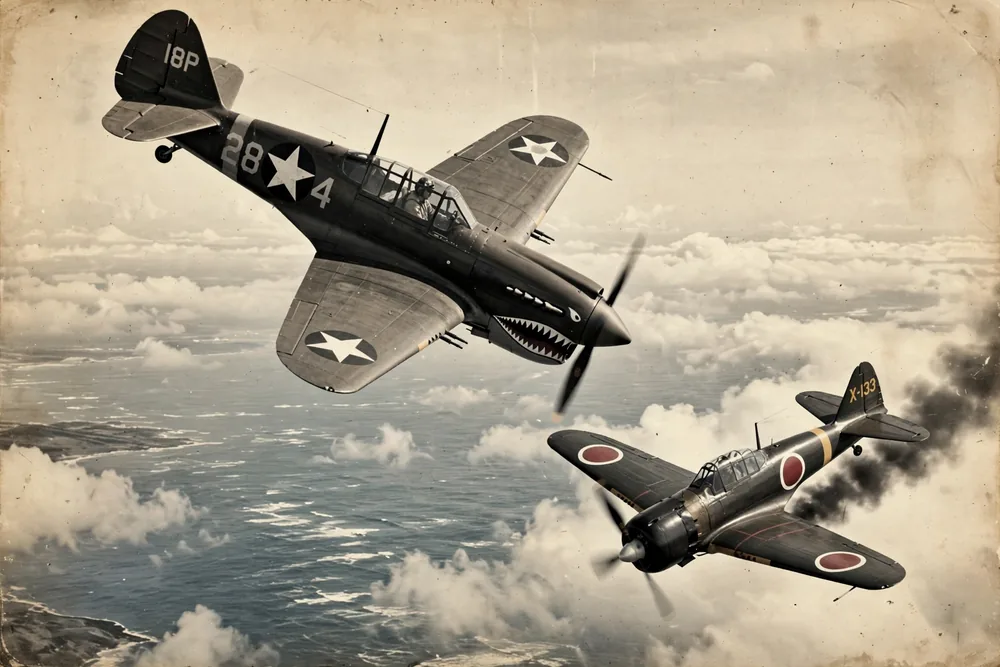
In a turning dogfight the Zero would almost always win, and the early war produced a string of one-sided combats in which P-40 pilots who tried to turn with the Zero were shot down. But the comparison was not one-sided: the P-40 was faster in a dive, it was far more heavily armed, it was structurally much stronger, and it could absorb damage that would have destroyed the lightly built Zero.
The Zero had no armour and no self-sealing fuel tanks in its early models, and a short burst from the P-40’s six .50-calibre guns could set it on fire. The pilots who survived learned to refuse the turning fight and to use the dive, the head-on pass and the two-ship element, and in those terms the P-40 was a match for the Zero.
By 1943 the arrival of the P-38, the F4U Corsair and the F6F Hellcat shifted the balance decisively, but the P-40 had held the line when there was nothing else.
9.2. Against the Messerschmitt Bf 109
Against the Messerschmitt Bf 109 the P-40’s disadvantages were more serious, because the German fighter was superior in almost every measure of performance that mattered in Europe. The Bf 109F and Bf 109G were faster than the P-40 at all altitudes, they climbed far more quickly, and their Daimler-Benz engines, fitted with efficient superchargers, retained their power at heights where the Allison faltered.
In North Africa the two types met frequently, and the results favoured the Germans whenever the fighting took place at high altitude, where the Bf 109 could dictate the terms of the engagement. At low altitude the comparison was closer: the P-40 was a stable gun platform, it dived well, and its six machine guns gave it a heavier weight of fire than the Bf 109’s cannon and machine-gun combination at close range, though the German cannon hit harder per round.
British and American pilots learned to fight the Bf 109 by staying low, by using the P-40’s dive, and by refusing to be drawn into climbing fights they could not win. The P-40 was never a match for the Bf 109 as a pure fighter, but it was good enough to do the work that the Mediterranean campaign required, and it bought time until the P-51 Mustang arrived with the performance to beat the German fighter on its own terms.
10. Legacy
10.1. A symbol of the early war
The P-40’s legacy is bound up with the early years of the war, when the Allies were losing and the aircraft’s shark mouth became a symbol of defiance. The Flying Tigers made the P-40 famous, and the fame outlived the aircraft’s front-line career: the shark mouth is still one of the most recognisable images of the Second World War, reproduced on model kits, in films and on the aircraft of modern air forces that paint it as a tribute.
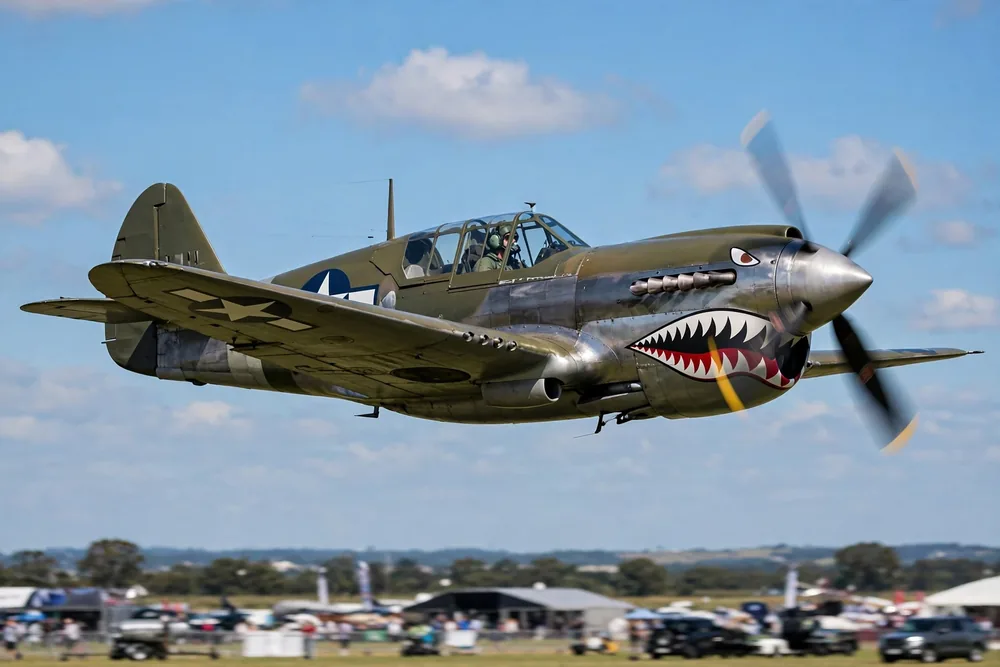
The P-40’s reputation as a rugged, honest aircraft also endured among the pilots who flew it, many of whom remembered it with more affection than they gave to the faster and more glamorous fighters that replaced it. The aircraft’s service with 28 air forces meant that it left its mark on aviation history in countries as far apart as Brazil, Turkey, China and the Soviet Union, and it was one of the first American military aircraft to be operated on a truly global scale.
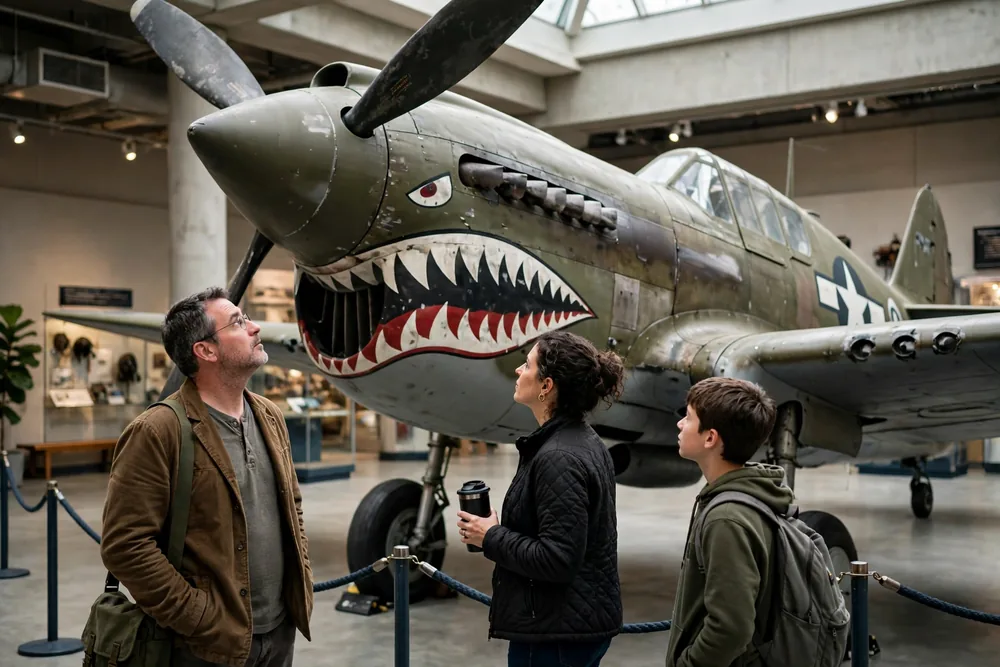
For historians, the P-40 is a case study in the value of availability: it was not the best fighter of the war, but it was the fighter that was there, in numbers, when it was needed, and that counted for more than perfection.
10.2. Survivors, restorations and memory
About thirty P-40s survive today in museums and in flying condition, a small number beside the 13,738 that were built, but a remarkable one for an aircraft that was worked hard and then scrapped in large numbers after the war.
Flying examples are maintained by private collectors and by heritage organisations in the United States, Britain, Australia and New Zealand, and they are regular performers at airshows, where the sound of the Allison engine and the sight of the shark mouth still draw crowds.
The most famous survivor is the P-40E flown by the Flying Tigers’ heritage flight, and several P-40s recovered from crash sites in the Pacific and in the Soviet Union have been restored to flying condition in recent decades. Museums that hold P-40s include the National Museum of the United States Air Force at Dayton, Ohio, the Smithsonian National Air and Space Museum and the Royal Air Force Museum in London.
The aircraft’s place in popular memory is secure: it appears in films, in video games and in the livery of the modern American Volunteer Group memorial flights, and for many people the shark-mouthed P-40 remains the visual shorthand for the air war of 1941 and 1942.
11. Frequently Asked Questions
How many P-40 Warhawks were built?
A total of 13,738 P-40s were built between 1939 and 1944, making it the third-most-produced American fighter of the Second World War, after the P-47 Thunderbolt and the P-51 Mustang. The most numerous single variant was the P-40N, with 5,220 built.
What was the P-40’s top speed?
The P-40E had a maximum speed of about 362 mph (582 km/h) at 15,000 feet. Later models were slightly faster: the P-40N reached about 378 mph. Above 20,000 feet, however, the P-40 lost performance sharply because its Allison engine lacked an efficient two-stage supercharger.
Why did the Flying Tigers paint shark mouths on their P-40s?
The shark mouth was copied from a Royal Air Force squadron in North Africa, whose P-40s carried the design. The Flying Tigers adopted it in China in 1941, and it became the most famous nose art of the war, later copied by P-40 units all over the world.
Was the P-40 a good fighter?
It was a good fighter at low and medium altitude and an excellent fighter-bomber, but a mediocre one at high altitude. Its strengths were ruggedness, heavy firepower, diving speed and ease of maintenance; its weaknesses were poor high-altitude performance, a modest climb rate and a vulnerable cooling system.
Which countries flew the P-40?
The P-40 served with 28 Allied air forces, including the United States, Britain, the Soviet Union, China, Australia, New Zealand, Canada and South Africa. The Soviet Union received about 2,000 under Lend-Lease.
Are any P-40s still flying?
Yes. About thirty P-40s survive in museums and in flying condition, maintained by private collectors and heritage organisations in the United States, Britain, Australia and New Zealand, and they appear regularly at airshows.
12. Sources
- Wikipedia, “Curtiss P-40 Warhawk” — first flight, production total of 13,738, P-40E performance figures and service history.
- National Museum of the United States Air Force, “Curtiss P-40E Warhawk” — specifications, Flying Tigers service and the Pearl Harbor story.
- Smithsonian National Air and Space Museum, Curtiss P-40 collection records — production, variants and the Allison V-1710 engine.
- Imperial War Museum, “Curtiss P-40 Kittyhawk” — RAF service in North Africa, the Tomahawk and Kittyhawk names.
- Dan Ford, Flying Tigers: Claire Chennault and His American Volunteers, 1941–1942 (Smithsonian Books, 2007) — the American Volunteer Group, its tactics and its victory claims.
- William Green, War Planes of the Second World War, Vol. 4: Fighters (Macdonald, 1961) — P-40 variants, performance and armament.
Further reading
- Carl Molesworth, P-40 Warhawk Aces of the Pacific (Osprey, 2003).
- John M. Andrade, U.S. Military Aircraft Designations and Serials since 1909 (Midland, 1979).