 WAR ATLAS MILITARY HISTORY MAGAZINE · WWI — WWII
British T-class Submarine
1. Lead
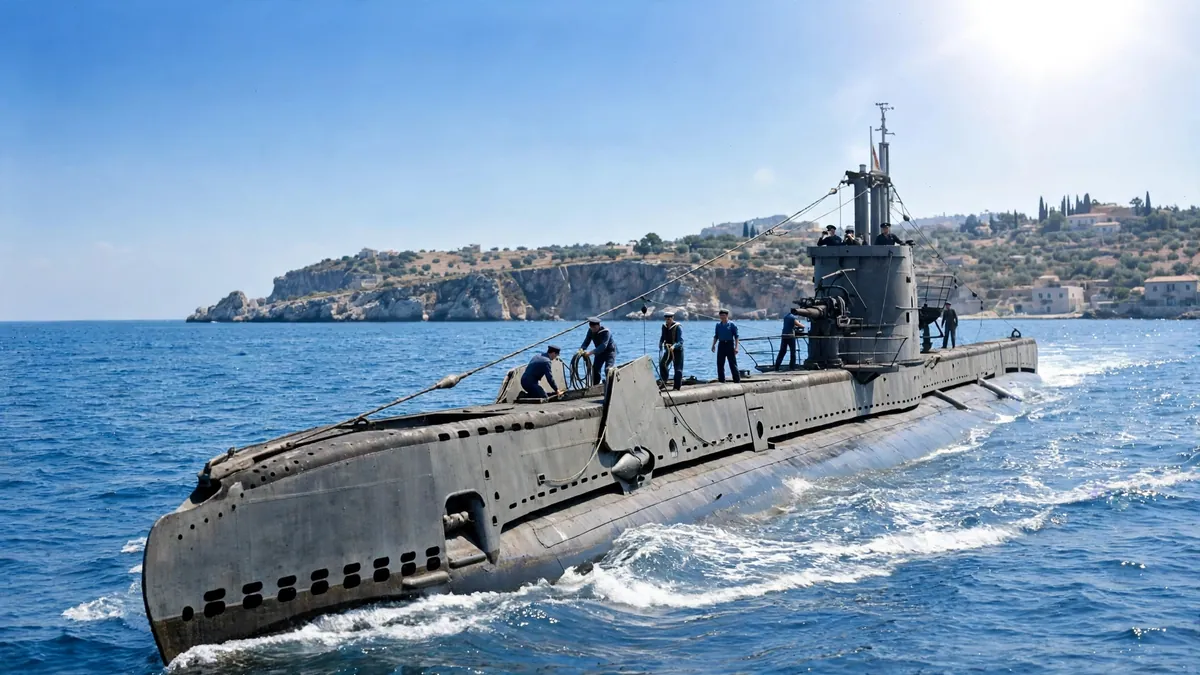
The British T-class submarine was the Royal Navy’s standard ocean-going patrol submarine of the Second World War, and one of the most numerous British submarine classes ever built. Fifty-three boats were completed between 1938 and 1945, in three successive groups, and they served in every theatre where the Royal Navy fought: the North Sea and the Norwegian coast, the Mediterranean against Italian and German supply lines, and the Far East against Japanese shipping.
Designed as a replacement for the ageing O, P and R classes, the T-class combined long range, a heavy torpedo armament of ten tubes, and a 4-inch deck gun into a hull of about 1,090 tons surfaced. It was not a perfect design — the boats were cramped, slow to dive by later standards, and their external torpedo tubes were difficult to reload at sea — but they were available in numbers, they were robust, and their crews took them everywhere the war demanded.
The T-class story is also the story of the submarine war in the Mediterranean, where the class earned its reputation and paid its heaviest price. Boats such as Torbay, Turbulent, Thrasher and Triumph attacked Axis convoys running between Italy and North Africa, sank warships and transports, landed agents and supplies for partisans, and carried out special operations along enemy coasts.
More than a dozen T-class boats were lost during the war, most of them in the Mediterranean, where clear water, heavy air patrols and dense minefields made submarine operations exceptionally dangerous. Yet the survivors kept fighting into 1945, and after the war the class continued in service — several boats were rebuilt with streamlined hulls and served into the 1960s, while others were transferred to allied navies, including the Netherlands, Israel and Australia.
2. Key Facts
| Class | T-class (Triton class), Royal Navy patrol submarine |
| Built | 1938–1945; 53 completed in three groups |
| Builders | Vickers-Armstrongs (Barrow), Cammell Laird, Scotts, Chatham and Devonport dockyards, among others |
| Displacement | About 1,090 tons surfaced; about 1,575 tons submerged (Group 1) |
| Length | About 84 m (275 ft) |
| Speed | About 15.25 knots surfaced; about 9 knots submerged |
| Range | About 8,000 nautical miles at 10 knots surfaced |
| Armament | 10 torpedo tubes (6 internal bow, 4 external); 16 torpedoes; 1 × 4-inch deck gun; anti-aircraft guns |
| Crew | About 59–61 officers and men |
| Wartime losses | More than a dozen boats lost, most in the Mediterranean |
| Famous boats | Torbay, Turbulent, Thrasher, Triumph, Taku, Thorn / Torbay, Turbulent, Thrasher, Triumph, Taku, Thorn |
3. Design and Development
Origins: replacing the O, P and R classes
In the early 1930s the Royal Navy’s patrol submarine force was built around the O, P and R classes, boats designed in the 1920s that were ageing fast and were too slow, too short-ranged and too lightly armed for the war the Admiralty expected.
The London Naval Treaty of 1930 had limited submarine numbers, and Britain needed a design that could be built in quantity within treaty limits while still carrying a heavy torpedo armament. The answer was the T-class, drawn up under the direction of the Director of Naval Construction and ordered as the Triton class — the first boat, HMS Triton, was laid down at Vickers-Armstrongs, Barrow-in-Furness, in 1936 and commissioned in November 1938.
The design accepted a larger hull than its predecessors in exchange for range and firepower, and it set the pattern for British patrol submarines for the rest of the war.
Hull, propulsion and diving
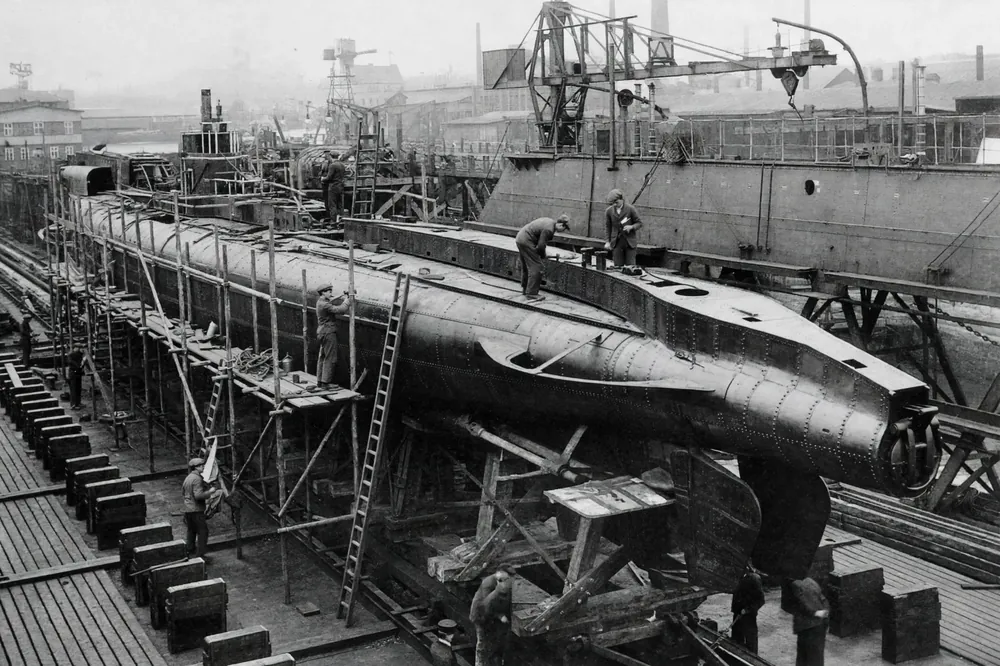
The T-class hull was about 84 metres long, with a riveted pressure hull and a saddle-tank arrangement that gave the boats their characteristic profile. Two Admiralty diesel engines, producing about 2,500 horsepower each, drove the boats on the surface, while electric motors powered them submerged from large battery banks.
Surfaced speed was about 15.25 knots and submerged speed about 9 knots, figures that were respectable for the late 1930s but that left the boats unable to chase fast convoys underwater. Diving time was around 45 to 60 seconds in good conditions, slower than German U-boats, and the boats were known to be noisy and cramped inside, with the crew of about sixty men living in very tight quarters on long patrols that could last six weeks or more.
The test depth was about 90 metres, though boats in service sometimes went deeper in emergencies, and the class proved structurally tough, surviving depth-charge attacks that would have broken lesser hulls.
The three groups
The 53 boats were built in three groups, each incorporating wartime lessons. Group 1, fifteen boats ordered before the war, carried ten torpedo tubes — six internal bow tubes and four external tubes, two in the bow and two amidships facing forward — with sixteen torpedoes in total and a 4-inch deck gun.
Group 2, seven boats, was similar but with improvements to the conning tower and internal layout, and the external tubes rearranged. Group 3, the wartime group of thirty-one boats, was built with a fully welded pressure hull in many cases, a simplified design for faster construction, and a revised torpedo arrangement with the external tubes moved aft in some boats.
Later Group 3 boats also received improved radar and anti-aircraft armament as the air threat grew. The differences between groups were modest compared with the common core: the same hull, the same engines, the same ten-tube punch that made the class the heaviest-armed British submarine of the war.
4. Armament and Sensors
Ten torpedo tubes
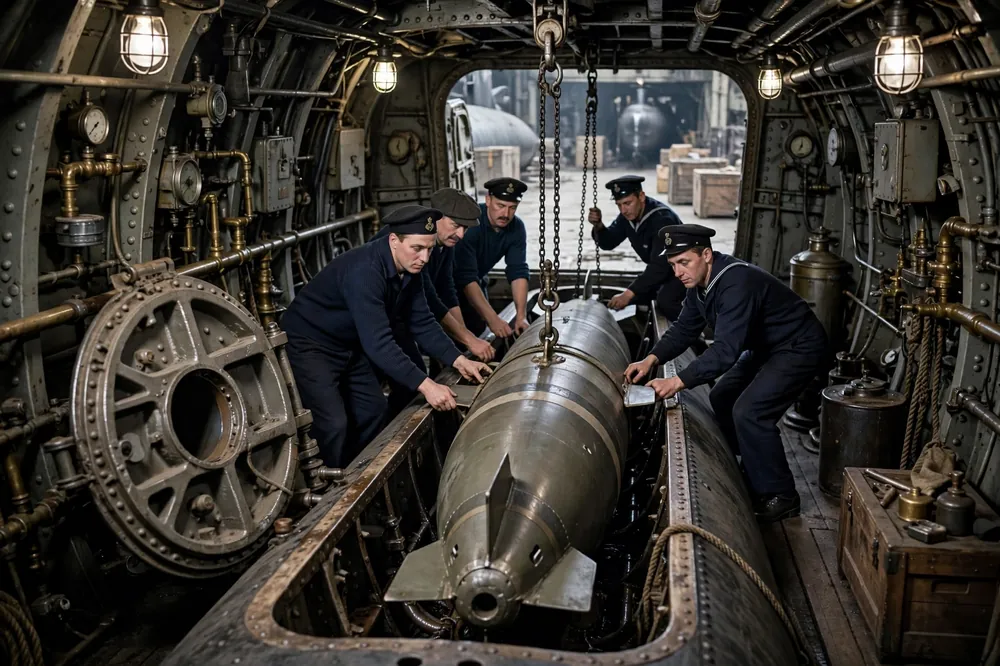
The defining feature of the T-class was its torpedo armament. Six internal bow tubes could be reloaded from the sixteen torpedoes carried aboard, while the four external tubes were loaded before sailing and could not be reloaded at sea, which meant that a T-class boat’s first salvo could be devastating but its staying power depended on the six reloadable tubes.
The standard weapon was the 21-inch Mark VIII torpedo, a reliable weapon with a warhead of about 340 kilograms and a range of roughly 4,500 metres at high speed, or much further at low speed. In practice, T-class commanders often fired spreads of several torpedoes to make up for the difficulty of hitting a moving target from a submerged boat with the fire-control equipment of the day.
The heavy armament suited the class’s main wartime job — attacking convoys — where a single boat might face several escorts and several merchant ships at once.
Deck gun and anti-aircraft defence
For surface action against small or unescorted vessels, the T-class carried a 4-inch (102 mm) deck gun mounted forward of the conning tower, a weapon that could sink a small merchant ship or a sailing vessel far more cheaply than a torpedo.
In the Mediterranean, where many targets were small coastal craft, the deck gun became a routine tool, and T-class boats sank numerous caiques, schooners and small steamers by gunfire. As the war went on, the air threat forced changes: early boats carried a single Lewis gun or a .303 machine gun on the bridge, but later boats received 20 mm Oerlikon cannon and improved anti-aircraft arrangements.
Even so, a submarine caught on the surface by aircraft was in grave danger, and T-class commanders learned to dive at the first sight of an aircraft — a discipline that saved many boats but also limited their freedom of action in the clear Mediterranean waters where aircraft could spot a submerged boat from the air.
Asdic, radar and fire control
The T-class was fitted with Asdic (sonar) for detecting submerged and surface contacts, a hydrophone set for passive listening, and a periscope attack system with a fire-control table that computed torpedo courses from the target’s bearing, range, course and speed. Early in the war the boats had no radar, and their commanders relied on the periscope and on lookouts.
From 1941 onwards, radar sets were fitted — first air-warning radar, then surface-search radar — which transformed night operations, allowing boats to detect convoys and escorts in darkness and to approach on the surface with far greater confidence. The combination of radar and the heavy torpedo armament made late-war T-class boats much more effective than their 1938 sisters, though the basic fire-control problem — hitting a ship that was zigzagging at 10 knots from a boat that could only manage 9 knots submerged — never went away.
5. Service in Home Waters
The North Sea and Norway
The first T-class boats entered service just as war broke out, and their early patrols were in the North Sea and off Norway. HMS Triton herself made history in the worst possible way on 10 September 1939, when she sank the British submarine HMS Oxley in a friendly-fire incident off Norway — the first British submarine loss of the war, and a reminder of how hard it was to tell friend from foe underwater in 1939.
Other boats patrolled the Norwegian coast during the German invasion of Norway in April 1940, attacking German transports and warships in the fjords and suffering from German air patrols and the long summer daylight that made surfaced operations dangerous. HMS Thistle was sunk by U-4 off Norway in April 1940, one of the rare cases of a submarine sinking another submarine while both were submerged in the war’s early years.
Atlantic patrols and the U-boat war
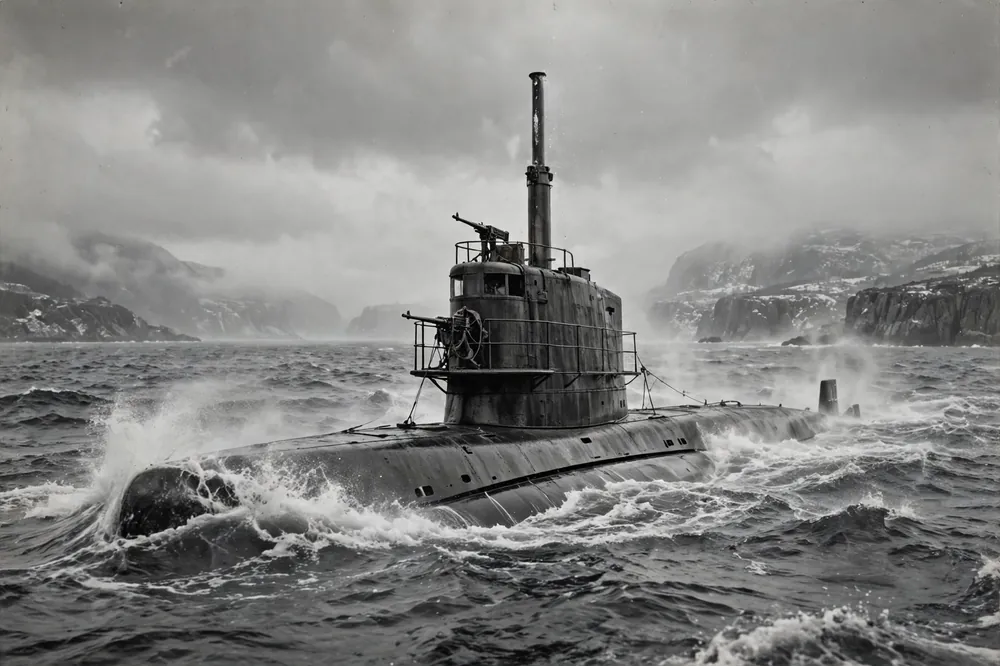
T-class boats also served in the Atlantic, where their long range made them useful for patrolling the approaches to Britain and for hunting U-boats. The work was unglamorous and often fruitless: weeks at sea, little contact with the enemy, and constant danger from German aircraft and from the weather.
The class’s most famous Atlantic action came in 1941, when HMS Tigris sank the German weather ship München and, in a separate operation, helped to secure Enigma materials — although the celebrated capture of Enigma documents is more often associated with other boats, the T-class contribution to the intelligence war was real and persistent.
Boats based at Holy Loch in Scotland ran patrols into the Bay of Biscay, where they watched the U-boat transit routes and occasionally attacked U-boats on the surface. The work demanded patience, and the T-class, with its long endurance and heavy armament, was well suited to it.
6. The Mediterranean Campaign
The convoy war to North Africa
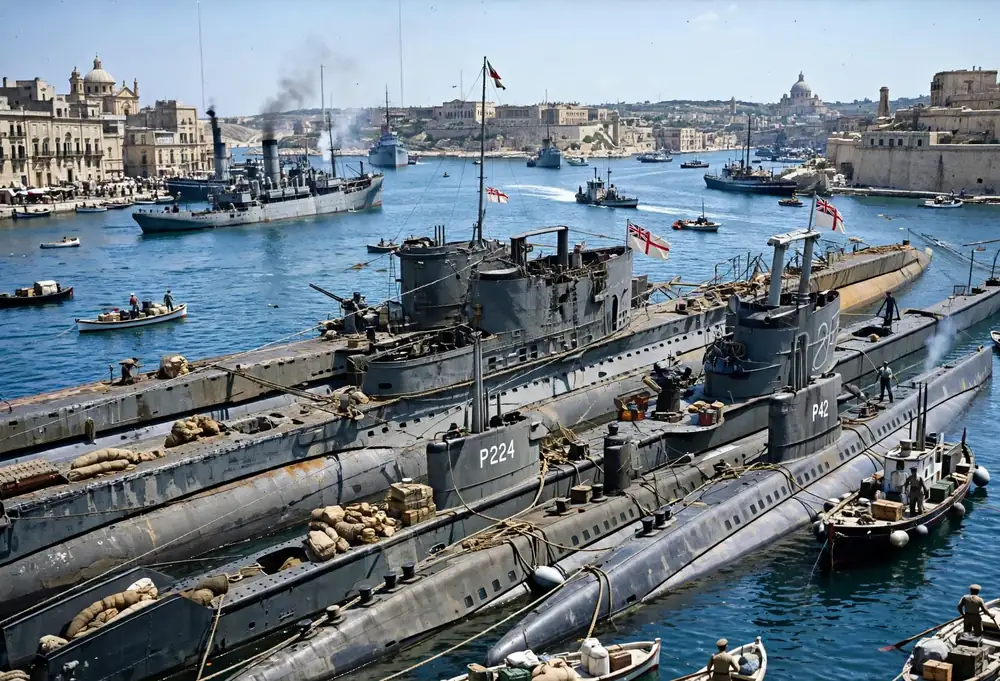
The Mediterranean was where the T-class fought its hardest war. From bases at Malta and Alexandria, T-class boats attacked the Axis convoys that carried men, tanks, fuel and ammunition from Italy to the German and Italian armies in Libya and Tunisia. The targets were rich and the escorts were strong, and the clear, shallow water made detection easy for Italian aircraft and destroyers.
Boats such as Turbulent, commanded by John “Tubby” Linton, sank a string of merchant ships and warships, including the Italian destroyer Emanuele Pessagno and the troop transport Nino Bixio, before Turbulent herself was lost in March 1943. Thrasher, under Lieutenant Commander Hugh Mackenzie, won a Victoria Cross action in February 1942 when Mackenzie and a petty officer removed unexploded bombs from the casing while the boat was under attack — one of the most celebrated acts of courage in the submarine service.
Special operations and the price paid
Mediterranean T-class boats did far more than attack shipping. They landed agents of the Special Operations Executive on enemy-held coasts, delivered supplies to partisans in Greece and Yugoslavia, reconnoitred landing beaches before the invasions of Sicily and Italy, and carried out the “human torpedo” and midget-submarine operations that became a hallmark of British special warfare.
HMS Torbay, under Commander Anthony Miers, sank the Italian submarine Guglielmotti and carried out repeated special operations, earning Miers the Victoria Cross. The price was heavy: boats lost in the Mediterranean included Triumph, Thorn, Tempest, Traveler, Trooper, Turbulent and Tetrarch, most of them to mines or to Italian and German anti-submarine forces.
The Mediterranean submarine campaign is often called the most dangerous submarine service of the war, and the T-class bore a large share of its losses — and of its successes.
7. Service in the Far East
Against Japanese shipping
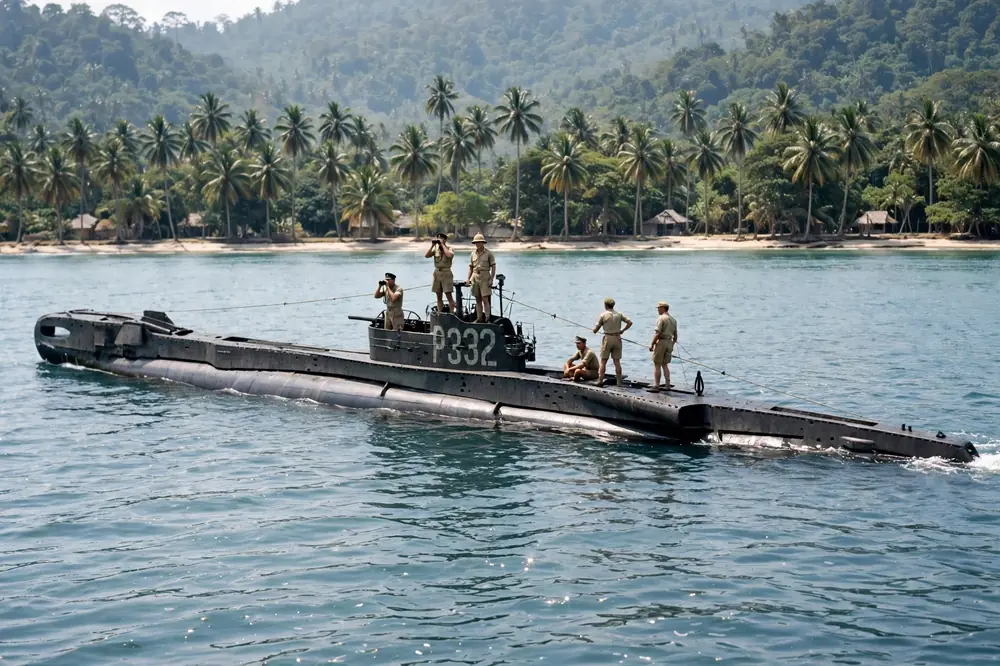
From 1942 onwards, T-class boats were sent to the Far East, operating from bases at Trincomalee in Ceylon and later from Fremantle in Australia. There they joined the campaign against Japanese merchant shipping in the Malacca Strait, the South China Sea and the waters around Sumatra and Borneo.
The targets were different from those in the Mediterranean — often small coastal vessels, junks and sailing craft carrying supplies for Japanese garrisons — and the deck gun became the main weapon, with boats sinking dozens of small craft by gunfire. Larger targets included tankers and transports, and T-class boats also laid mines in Japanese-held harbours.
The tropical heat made life aboard the boats miserable, with temperatures inside the hull reaching 40 degrees Celsius or more, but the boats kept up a steady pressure on Japanese coastal supply lines until the end of the war.
Special operations in the Pacific
In the Far East, T-class boats also carried out special operations, including landing agents on Japanese-held coasts and supporting the covert operations that preceded the liberation of Malaya and Borneo. HMS Trenchant sank the Japanese cruiser Ashigara in June 1945 in the Bangka Strait, one of the last major warship sinkings by a British submarine in the war — a fitting final success for the class.
Other boats, such as Taciturn and Thorough, operated off Sumatra and in the Malacca Strait until the Japanese surrender, attacking shipping and rescuing downed airmen. The Far East campaign showed the class’s versatility: the same boats that had fought in the Atlantic and the Mediterranean adapted to a completely different war, against a different enemy, in different waters, and with different targets.
8. Notable Boats and Commanders
John Linton and HMS Turbulent
Lieutenant Commander John Wallace Linton, known as “Tubby” Linton, was the most successful T-class commander of the war and one of the most decorated submarine officers in Royal Navy history. Commanding HMS Turbulent in the Mediterranean from 1941 to 1943, he sank or damaged more than 90,000 tons of Axis shipping, including warships and transports, and he was awarded the Victoria Cross, the Distinguished Service Order and the Distinguished Service Cross.
Linton and Turbulent were lost in March 1943, probably to Italian anti-submarine forces off Corsica, and the Victoria Cross was awarded posthumously. His record — and the fact that he achieved it in the most dangerous submarine theatre of the war — made him the embodiment of the T-class in the Mediterranean, and his name remains one of the best known in the submarine service.
Anthony Miers, Hugh Mackenzie and others
Commander Anthony Miers of HMS Torbay won the Victoria Cross for a series of daring attacks and special operations in the Mediterranean, including sinking the Italian submarine Guglielmotti and carrying out repeated landings of agents on enemy coasts. Lieutenant Commander Hugh Mackenzie of HMS Thrasher won his Victoria Cross in February 1942 when, after his boat was bombed, he and Petty Officer Thomas Gould climbed onto the casing in darkness and removed two unexploded bombs by hand while the boat was still under attack — Gould also received the Victoria Cross.
Other notable commanders included Commander John “Tubby” Linton’s contemporaries in the Mediterranean flotillas, and in the Far East, Commander Arthur Hezlet of HMS Trenchant, who sank Ashigara. The class produced four Victoria Crosses in total, a remarkable record for a single submarine class, and one that reflects both the danger of the work and the quality of the men who did it.
9. Variants and Post-War Service
The Super T conversions
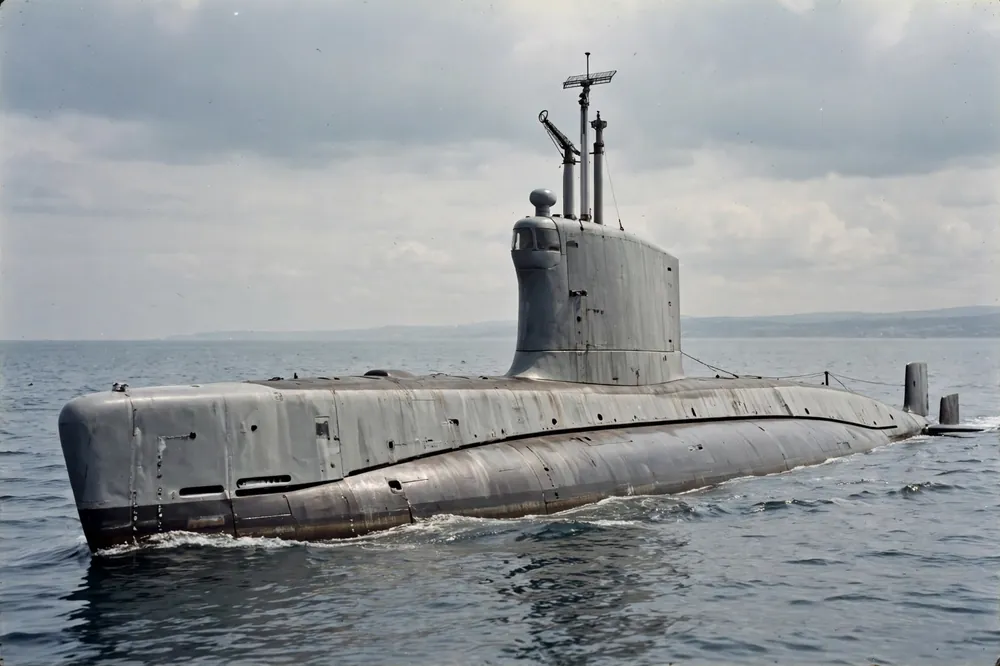
After the war, the surviving T-class boats were too valuable to discard and too old-fashioned to keep as they were. Eight boats were rebuilt between 1948 and 1956 as “Super T” conversions, with streamlined hulls, a single large fin, improved batteries and snorkels, and the external torpedo tubes removed. The conversions were based on lessons learned from German Type XXI U-boats, and they gave the boats a much higher submerged speed and far better underwater endurance, though they remained recognisably T-class boats underneath. The Super T boats — including Taciturn, Talent, Thermopylae and Turpin — served into the 1960s as training boats and as part of Britain’s Cold War submarine force, long after their sisters had been scrapped.
Transfers to allied navies
Other T-class boats found second lives abroad. Boats were transferred to the Royal Netherlands Navy, where they served as Tijgerhaai and others, to the Israeli Navy as Dolphin and Leviathan, and to the Australian Navy. The Israeli boats, in particular, were the foundation of Israel’s submarine force, and one of them, the former HMS Turpin, served as INS Leviathan until 1973.
The last T-class boats in British service were paid off in the late 1960s, and the final survivor, the former HMS Alliance — a Group 3 boat completed in 1947 — was preserved as a museum ship at Gosport, where she remains on display today as the memorial to the British submarine service and to the seventy boats and their crews lost in the Second World War.
10. Assessment and Legacy
The T-class was not the best submarine of the Second World War — that honour is usually given to the German Type VII and Type XXI, or to the American fleet boats — but it was the right submarine for the Royal Navy’s war.
It was available in numbers when Britain needed submarines most, it was tough enough to survive in the Mediterranean, and it carried a torpedo armament heavy enough to threaten any convoy. Its weaknesses were real: it was slow to dive, cramped, and noisy, and its external torpedo tubes were a compromise that added firepower at the cost of flexibility.
Yet the class’s record speaks for itself: more than a dozen boats lost, but a far larger number of Axis ships sunk, four Victoria Crosses, and a service record that spanned every theatre of the war.
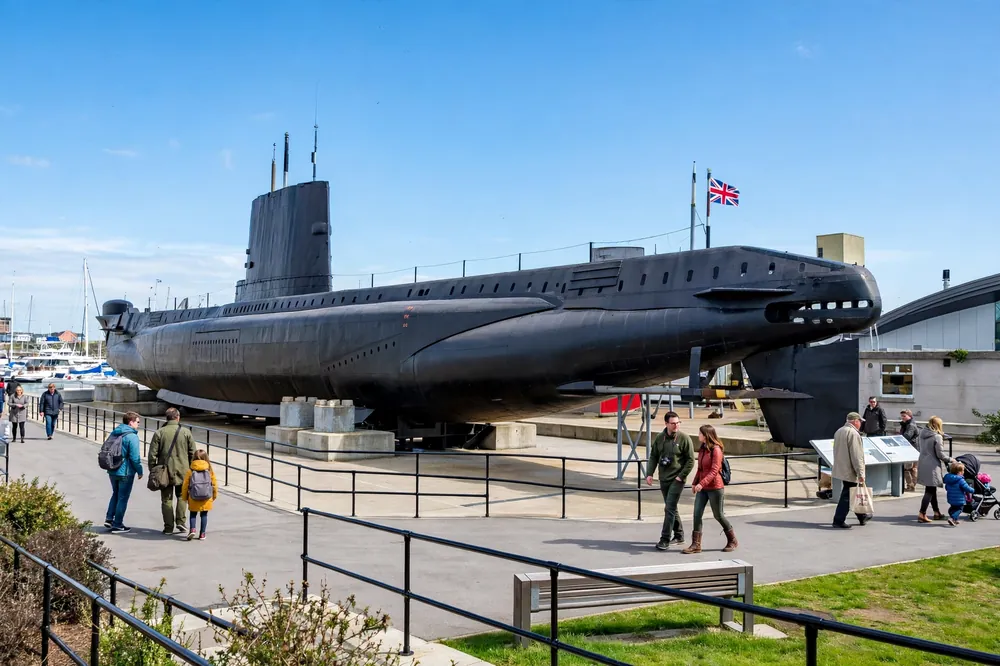
Today, the T-class is remembered chiefly through HMS Alliance at Gosport, a museum ship that preserves the cramped, oily, claustrophobic world of the wartime submarine service for visitors who can climb through her hatches and see how sixty men lived and fought in a steel tube 84 metres long.
The class’s real legacy, though, is in the Royal Navy’s submarine tradition: the T-class proved that British submarines could fight a long, hard war against convoys, against warships, and against the air and mine threat, and it set the standard for the patrol submarines that followed — the A-class, the Porpoise class and the Oberon class.
For the historian, the T-class is the submarine of the Mediterranean campaign, and for the Royal Navy, it remains the class that did the most work with the least recognition.
11. Frequently Asked Questions
How many T-class submarines were built?
Fifty-three T-class submarines were completed between 1938 and 1945, in three groups: fifteen in Group 1, seven in Group 2 and thirty-one in Group 3. A small number of additional boats were ordered but cancelled, and one boat, HMS Alliance, was completed after the war in 1947. The class was the most numerous British patrol submarine class of the war. The total matters because it made the T-class the backbone of the British submarine service: with 53 boats, the class could be everywhere the Royal Navy fought, from the North Sea to the Far East.
Why did the T-class have ten torpedo tubes?
The ten tubes — six internal bow tubes and four external tubes — gave the T-class the heaviest torpedo armament of any British submarine of the war, and they were designed for attacking convoys, where a single boat might need to fire a large salvo at several ships at once. The external tubes could not be reloaded at sea, so the design traded staying power for a devastating first attack. The design was a deliberate trade: the external tubes gave the boat a devastating first salvo, but they could not be reloaded at sea, so the boat’s staying power was limited.
How many T-class submarines were lost in the war?
More than a dozen T-class boats were lost during the Second World War, most of them in the Mediterranean, where mines, aircraft and Italian and German anti-submarine forces made operations exceptionally dangerous. The exact figure varies between sources because some boats were lost to unknown causes, but the Mediterranean accounted for the majority of the losses, including Triumph, Thorn, Tempest, Turbulent and Tetrarch. The Mediterranean was the deadliest theatre for the class, because the sea was narrow, the enemy’s air and anti-submarine forces were strong, and the boats had to operate close to enemy bases.
What was the T-class’s most famous action?
The most celebrated single action was probably the Victoria Cross action aboard HMS Thrasher in February 1942, when Lieutenant Commander Hugh Mackenzie and Petty Officer Thomas Gould removed two unexploded bombs from the casing by hand while the boat was under attack. The class’s most successful commander was John Linton of HMS Turbulent, who sank more than 90,000 tons of Axis shipping before his boat was lost in March 1943. The two stories show different sides of the class: Thrasher’s action was a single act of courage under fire, while Linton’s record was the result of months of patient hunting.
Did any T-class submarines survive to the present day?
Yes. HMS Alliance, a Group 3 boat completed in 1947, is preserved as a museum ship at the Royal Navy Submarine Museum in Gosport, England. She is the only surviving T-class submarine, and she serves as the memorial to the British submarine service of the Second World War. Other boats survived into the 1960s and 1970s in foreign navies, notably Israel’s INS Leviathan, the former HMS Turpin. Alliance survives because she was completed after the war, and she never faced the dangers that destroyed her sisters. As a museum ship at Gosport, she serves as the memorial to the British submarine service of the Second World War.
How did the T-class compare with German U-boats?
The T-class was larger and carried a heavier torpedo armament than the standard German Type VII U-boat, with ten tubes against five, but it was slower to dive, noisier and less manoeuvrable underwater. The Type VII was designed for the Atlantic convoy war, while the T-class was designed as a general-purpose patrol submarine for worldwide service. In the Mediterranean, where the T-class fought most of its war, the comparison mattered less than the skill of the commanders and the difficulty of the theatre.
12. Sources
- Wikipedia, “British T-class submarine” — construction figures (53 boats, three groups), dimensions, armament and wartime losses.
- Paul Akermann, Encyclopaedia of British Submarines 1901–1955 (Periscope Publishing, 2002) — class history, group differences and individual boat fates.
- Norman Friedman, British Submarines in the Age of the World Wars (Seaforth, 2019) — design background and the Admiralty’s patrol submarine policy.
- Royal Navy Submarine Museum, Gosport — HMS Alliance and the T-class display; the museum’s account of the class.
- John Wingate, The Fighting Tenth: The Tenth Submarine Flotilla and the Siege of Malta (Periscope Publishing, 2003) — the Mediterranean campaign and the T-class flotilla at Malta.
- Richard Compton-Hall, Submarines at War 1939–45 (Periscope Publishing, 2004) — T-class operations in the Mediterranean and the Far East.
- Innes McCartney, British Submarines 1939–45 (Osprey New Vanguard, 2006).
- Derek Walters, The History of the British ‘U’ Class Submarine (Pen & Sword, 2004) — for comparison with the contemporary U-class.